Sacred Geometry Symbols and Meanings: Reading the Blueprint of Creation
Holistic KingdomJuly 5, 2026Updated July 13, 2026

Before there was writing, there was pattern.
A nautilus shell curling outward in perfect proportion. Six-sided crystals of ice landing on a sleeve. The seed head of a sunflower spiraling in two directions at once. The people who first noticed these repetitions — and they noticed them everywhere — drew a conclusion that has echoed through every great civilization since: the universe is not improvised. It is composed.
Sacred geometry is the study of that composition. It is the observation that certain shapes and ratios recur throughout nature at every scale, from the whorl of a fingerprint to the arms of the galaxy — and the ancient conviction that these patterns are not coincidence but language: the energetic blueprint by which creation organizes itself. Where the physicist sees efficient mathematics, the mystic sees signature. Sacred geometry has always lived at the meeting point of the two, and it invites us to stand there as well.
This is the foundational guide to that language — where it comes from, what its essential symbols mean, and how to bring its quiet order into your practice and your home.
At its heart, sacred geometry rests on a simple premise: everything in existence is energy, and energy does not move randomly. It flows in patterns — waves, spirals, lattices, branches. The forms we call sacred are the shapes those patterns make when they become visible.
Traditions across the world have held that because we are made of the same energy, patterned by the same geometry, these symbols act as a kind of intermediary between the human and the cosmic. To contemplate them is to recognize something of our own architecture. This is why the same handful of forms appears in Hindu yantras, Gothic rose windows, Islamic tilework, and Egyptian temples — cultures with no contact arriving at the same vocabulary, because they were all transcribing from the same source: nature itself.
Sacred geometry was never one culture's invention. The builders of Egypt aligned monuments to sky and season with astonishing precision. Greek philosophers — Pythagoras foremost among them — taught that number and proportion were the closest humans could come to touching the divine order, and Plato went so far as to associate the five perfect solids with the elements of creation itself. In India, the yantra tradition refined geometric meditation into a precise contemplative science. Mesoamerican civilizations encoded celestial cycles into the very footprints of their pyramids and cities.
The thread continues through the Renaissance, when Leonardo da Vinci illustrated a treatise on divine proportion and Johannes Kepler searched for the geometry underlying the orbits of the planets — and it continues today, every time an architect reaches for proportions that simply feel right and cannot fully say why.
For all its cosmic scope, sacred geometry earns its place in daily life through practice. Three doorways are the most walked:
Contemplation and meditation. The oldest use of these symbols is simply to gaze upon them. A yantra or mandala gives the restless mind a structure to settle into — the eye follows the pattern, the pattern steadies the attention, and attention itself becomes the offering. Many practitioners visualize a chosen form (the Flower of Life and the Merkaba are favorites) during meditation as a focal point for intention.
Energy work and healing arts. Practitioners of energy healing modalities often incorporate geometric visualization into their work — picturing forms of balance and coherence as an anchor for the session's intention. Whatever one's framework for how such work operates, the geometry serves as a shared symbolic language between practitioner, recipient, and tradition.
Living with the forms. The most accessible doorway of all: wearing the symbols, placing them in the home, choosing objects and spaces whose proportions carry the old harmonies — and joining them to ritual and daily practice, where symbols stop being decoration and become instruments. More on the quiet art of geometric living at the end of this guide.
These ten forms are the pillars of the tradition — the shapes you will meet again and again in temples, texts, and talismans, each carrying centuries of accumulated meaning.
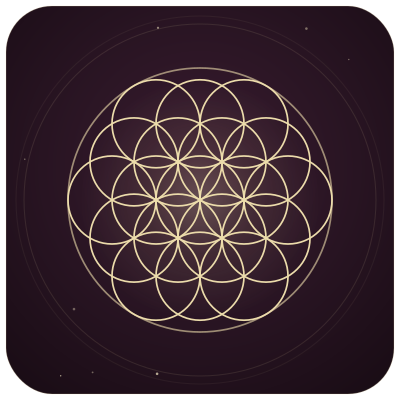
Formed of nineteen equal, overlapping circles, each passing through the centers of its neighbors, the Flower of Life is often called the fabric of the universe — because within its lattice, nearly every other sacred form can be found waiting. The Seed of Life rests at its center; the lines of Metatron's Cube can be drawn from its intersections. It is the tradition's master template, symbolizing creation unfolding from source in perfect harmony, balance, and interconnection. Versions of it appear carved and painted from Egypt to India to China — one of humanity's most widely traveled symbols.
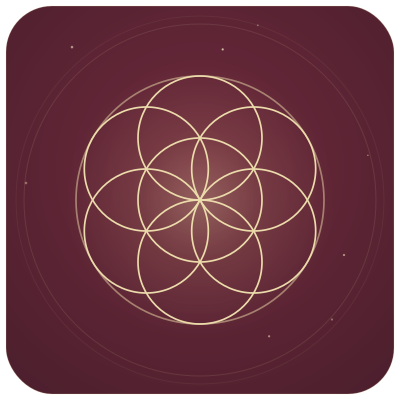
Six circles arranged around a seventh, all of equal size, intersecting at their centers to form a rosette: the Seed of Life is the Flower in embryo, the first stage of the pattern's unfolding. Many traditions read its sevenfold structure as an echo of creation stories built on seven days or seven stages. It carries the meanings of genesis, fertility, regeneration, and the intelligence folded inside every beginning — the entire flower already present in the seed.
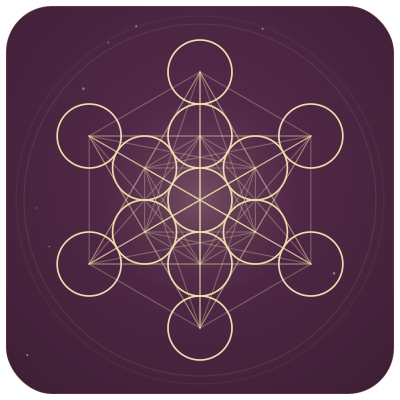
Draw thirteen circles — one at center, twelve around — then connect every center to every other with straight lines, and Metatron's Cube emerges: a figure of remarkable density in which the outlines of all five Platonic solids can be traced. Named for the archangel said to record all things, it represents the passage from idea to form — the process by which the unmanifest becomes manifest. Its traditional associations are ingenuity, resilience, protection, and the deep interconnection of all things.
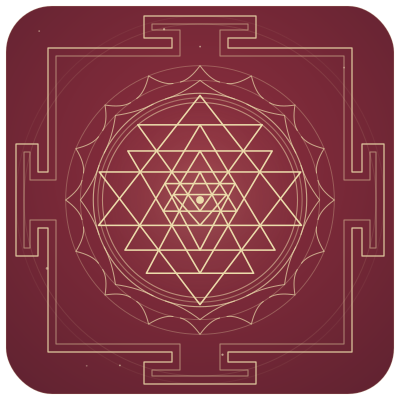
Nine interlocking triangles — four pointing upward, five downward — radiate from a central point called the bindu, generating forty-three smaller triangles in their interference. The Sri Yantra is among the most revered objects of contemplation in the Indian tradition, embodying the union of divine masculine and divine feminine energies and, through the bindu, the point where the manifest world touches its source. It is associated with abundance, higher consciousness, and connection to spirit, and gazing meditation upon it is a practice refined over many centuries.
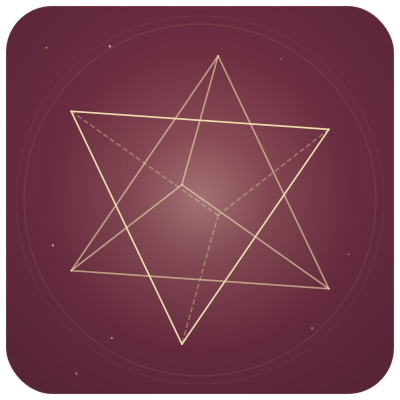
Two tetrahedrons interlocked in opposite orientations, sharing a common center, form the three-dimensional eight-pointed star known as the Merkaba. The name is often rendered from Hebrew as chariot, and in mystical tradition it is exactly that — the light-body vehicle of the soul, the geometry of spirit in motion. It carries meanings of wholeness, expansion, protection in transit (literal and spiritual), and the marriage of complementary forces: heaven-pointing and earth-pointing, spirit and matter, in one balanced form.
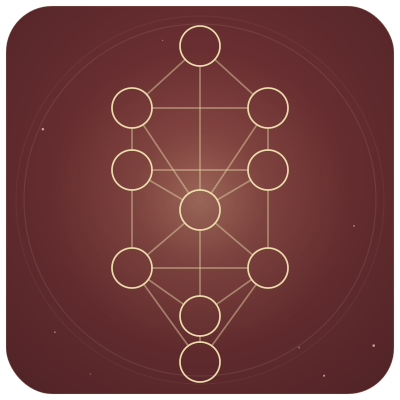
Ten spheres — the sephirot, or emanations — arranged in three columns and joined by twenty-two connecting paths: together, the mystics of Kabbalah called these the thirty-two paths of wisdom. The Tree of Life is a complete map of the spiritual journey, from the most transcendent emanation down to the rooted world of matter, and every path between them is a lesson. It speaks of personal development, transformation, and ascension that never loses its grounding — the crown reached only by way of the root.
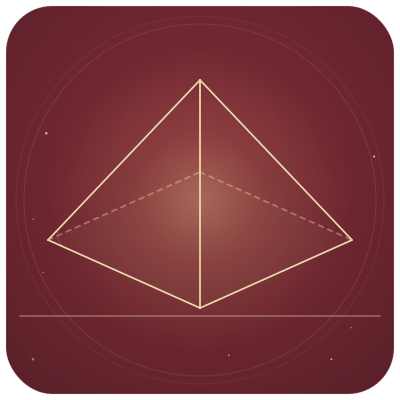
A square base rising to a single apex: the pyramid is sacred geometry at architectural scale, and the civilizations that built them — Egyptian, Mesoamerican, and beyond — clearly considered the form itself potent. Many observers through the centuries have noted proportions in the great monuments that approach the golden ratio, though the builders kept their reasoning to themselves. Symbolically the reading is consistent across traditions: the base is the body and the earthly world; the converging sides are the paths of ascent; the apex is unity — the single point where all ways meet. In modern practice, pyramid forms are kept in homes and meditation spaces as emblems of focus, aspiration, and the concentration of intention.
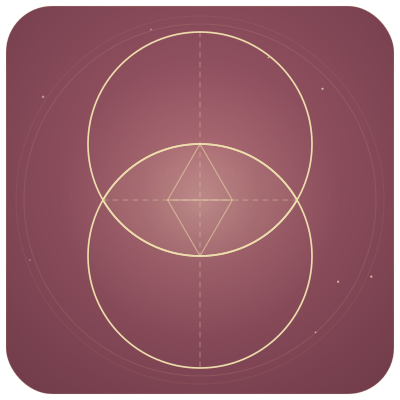
Two identical circles drawn so that the center of each rests on the circumference of the other create, in their overlap, an almond-shaped field called the mandorla — the Vesica Piscis. It is the geometry of union: two becoming a third thing that belongs to both. Tradition names it the womb of the universe, the gateway between worlds, and its almond frame surrounds sacred figures in the art of many faiths. Geometers have long prized the elegant ratios hidden in its construction. Its meanings are conception, renewal, vitality, and divine union — the creative power of overlap itself.
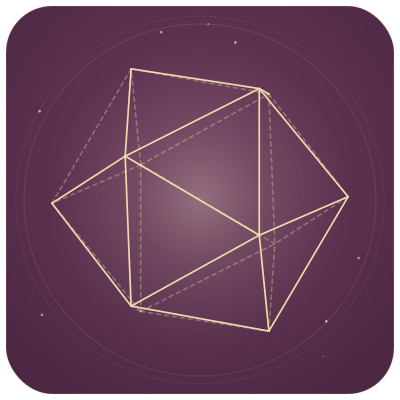
One of Plato's five perfect solids, the icosahedron is composed of twenty equilateral triangles, with five meeting at each of its twelve vertices — a form so evenly distributed it seems almost to flow. Plato associated it with water, and the tradition has followed him ever since: the icosahedron is the geometry of adaptability, ease, and natural movement. It is invoked in practice as a companion for creative unblocking and emotional flow — for the seasons of life that ask us to move like water rather than stand like stone.
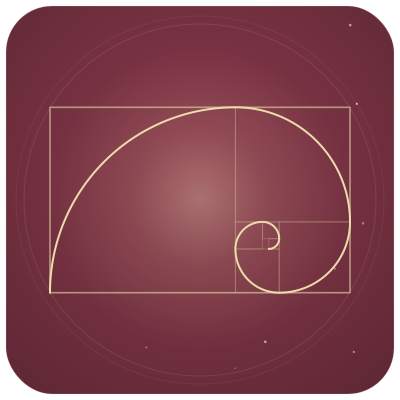
Begin with a rectangle of perfect proportion, divide it, divide again, and trace a curve through the corners: the spiral that emerges expands by the golden ratio — phi, approximately 1.618 — at every turn. This is the pattern nature reaches for when it grows: in the nautilus shell, the fern's unfurling frond, the seed heads of flowers, the sweep of galactic arms. Sometimes called the pattern of the universe, the golden spiral symbolizes expansion without distortion — growth that remains itself at every scale. Of all the sacred forms, it is the one you can most easily find in a morning walk.
It's worth pausing on that last point, because it is the tradition's quiet proof. Sacred geometry is not an abstraction imposed on the world; it is an observation drawn from it. Honeybees build hexagons. Sunflowers count in the golden sequence. River deltas branch like lightning branches like lungs. Snowflakes improvise endlessly inside sixfold symmetry. We explore these living patterns in depth in the vibrational blueprints of the natural world.
Once you begin looking, the patterns are everywhere — and that looking is itself a practice. It trains the eye toward coherence and the mind toward wonder. A walk through a garden becomes a gallery visit. This may be sacred geometry's most generous gift: it makes the ordinary world legible as art.
Step into a great cathedral, a temple, a well-proportioned old library — and then into a fluorescent-lit cubicle farm — and you will feel the difference before you can explain it. Spaces shape states. The traditions behind sacred architecture understood this deeply: proportion, symmetry, and form were not decoration but a technology of atmosphere, deployed deliberately to lift the human spirit toward the harmonious. (Creating that feeling in a modern, device-crowded home is its own art — one we explore in our guide to quiet spaces.)
You don't need a cathedral budget to work with the same principles. Bringing sacred geometry into your environment can be as simple as:
None of this requires belief so much as attention. The invitation of sacred geometry has always been experiential: place the forms in your field of vision, live with them a while, and notice what changes in the quality of your attention and the feeling of your rooms.
Every tradition that studied these forms arrived at the same essential insight: harmony is not something we invent — it is something we recognize. The proportions that steady a building steady a mind. The spiral that grows a shell grows a life. To study sacred geometry is to practice that recognition until it becomes a way of seeing, and eventually a way of living: more aligned with nature's rhythms, more attentive to the composition of our spaces and days, more at home in a universe that has, from the beginning, been drawing the same beautiful figures over and over — and inviting us to notice.
The blueprint was never hidden. It was simply waiting to be read.

Mandalas are sacred geometry in devotional form — the circle as a map of the cosmos. Here's how the two traditions connect across Hindu, Buddhist, Christian, and psychological lineages, and how to work with mandalas yourself.

Sacred geometry tattoos express alignment with the patterns underlying creation — but each symbol carries its own history, meaning, and cultural weight. Here's what the major designs mean and what to weigh before the needle touches skin.

Sacred geometry meditation uses forms like the Sri Yantra, Flower of Life, and Merkaba as anchors for attention. Here are four methods — gazing, visualization, drawing, and breath pairing — and how to practice each one honestly.