The Icosahedron and the Platonic Solids: The Five Shapes and Their Elements
Holistic KingdomSeptember 18, 2026Updated September 25, 2026

Some shapes feel discovered rather than invented — and no family of forms carries that feeling more strongly than the Platonic solids.
An icosahedron is a three-dimensional shape built from twenty identical equilateral triangles, meeting five at every corner: 20 faces, 30 edges, 12 vertices. It is one of exactly five shapes in existence — the Platonic solids — whose faces are all identical regular polygons and whose corners are all indistinguishable from one another. The other four are the tetrahedron (4 triangular faces), the cube (6 squares), the octahedron (8 triangles), and the dodecahedron (12 pentagons). In classical Greek philosophy, each solid was paired with an element: the tetrahedron with fire, the cube with earth, the octahedron with air, the icosahedron with water, and the dodecahedron with the heavens themselves — the fifth element, aether. That elemental map comes from Plato's dialogue Timaeus, written around 360 BCE, and it has shaped how mystics, alchemists, and geometers have read these five forms ever since.
Two things are true about the Platonic solids at once, and it's worth holding both. The claim that only five such shapes can exist is not folklore — it is settled mathematics, proven in antiquity and never overturned. The elemental correspondences, by contrast, are philosophy and tradition: a beautiful, influential way of reading the shapes, not a scientific description of matter. Understanding where the math ends and the meaning begins is exactly what makes these forms rewarding to study — and it's the same lens we apply across the whole language of sacred geometry.
The rule defining a Platonic solid is strict: every face must be the same regular polygon, and the same number of faces must meet at every vertex. Under those constraints, geometry runs out of room remarkably fast.
To form a solid corner, the angles meeting at a vertex must total less than 360 degrees — otherwise the surface lies flat or buckles. Equilateral triangles (60° each) can meet three, four, or five at a corner, giving the tetrahedron, octahedron, and icosahedron. Squares (90°) can only meet three at a corner: the cube. Pentagons (108°) can also only meet three: the dodecahedron. Hexagons fail immediately — three of them make exactly 360° and tile a flat plane instead of closing into a solid. Anything with more sides fails harder.
That's the entire proof, in miniature. Five shapes, no more, ever — in this universe or any other with the same geometry. The result was known to the Greek mathematician Theaetetus in the fourth century BCE, and Euclid's Elements closes its thirteenth and final book by constructing all five and proving the list complete. The ancients found this fact genuinely uncanny: an infinite universe of possible forms, and perfection permits exactly five. It's not hard to see why Plato concluded they must be structurally important to reality itself.

In the Timaeus, Plato proposed that the four classical elements were literally composed of tiny geometric particles — an early, intuitive ancestor of atomic theory. His assignments followed the character of each shape:
Each solid also has a dual: connect the center points of one solid's faces and you get another Platonic solid. The cube and octahedron are duals; so are the dodecahedron and icosahedron — meaning water and aether, earth and air, are geometric mirrors of one another. Traditions that read symbolism into structure have found that pairing meaningful for over two millennia.

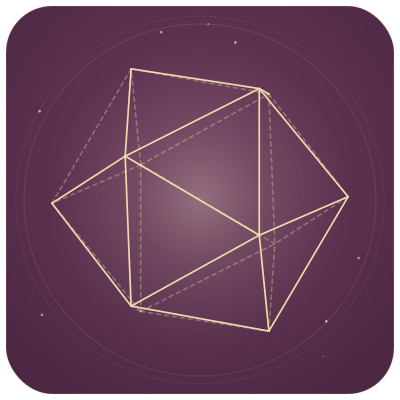
Of the five, the icosahedron rewards the closest look. With twenty faces, thirty edges, and twelve vertices, it is the roundest of the triangle-built solids — the one that most wants to be a sphere. That efficiency isn't just aesthetic: distributing points evenly around a center is a genuinely hard mathematical problem, and the icosahedron's twelve vertices are one of nature's favorite solutions to it.
There's a hidden elegance in how those vertices sit in space. Take three identical rectangles whose sides are in the proportion of the golden ratio, interlock them at right angles like a three-dimensional plus sign, and their twelve corners land exactly on the vertices of a perfect icosahedron. The shape most associated with water is quietly built from the proportion most associated with life and growth — a convergence that sacred geometry traditions have treasured, and that mathematicians simply confirm.
Symbolically, the icosahedron's watery assignment has made it the solid of flow, emotion, adaptability, and trust. Practitioners who work with the solids in meditation often reach for the icosahedron when life demands surrender rather than control — when the task is to move around the obstacle rather than through it. That is a use of the shape, not a property of it; the geometry doesn't care what we bring to it. But as a focal image for a particular quality of mind, it has earned its long tenure.
The solids' influence didn't end with antiquity. In 1596, Johannes Kepler published his Mysterium Cosmographicum, proposing that the orbits of the six known planets were spaced by the five Platonic solids nested one inside another — cube, tetrahedron, dodecahedron, icosahedron, octahedron, each inscribed in a sphere. The model was wrong, and Kepler eventually abandoned it. But the obsessive precision it demanded led him directly to the observational work that produced his three laws of planetary motion — the foundation on which Newton built.
It's one of history's better lessons about sacred geometry: the conviction that the cosmos is mathematically composed turned out to be right, even when the specific mysticism was wrong. The solids were never the architecture of the solar system, but the instinct that pattern underlies the heavens was vindicated in full.
The five solids also live inside another famous figure. Draw lines connecting the thirteen circles of the Fruit of Life pattern and you get Metatron's Cube, from which all five Platonic solids can be traced — a relationship worth its own exploration, which you'll find in our guide to Metatron's Cube.
Here the honest news is genuinely good. Unlike some sacred geometry claims that dissolve under scrutiny, the Platonic solids show up in the physical world in well-documented ways.
Crystals are the clearest case: table salt and pyrite crystallize as cubes, fluorite and magnetite form natural octahedra, and pyrite also produces near-dodecahedral forms. These aren't approximations imposed by hopeful eyes — they follow directly from how atoms pack in a lattice.
The icosahedron has an even more striking home: virology. A huge number of viruses — including adenoviruses and herpesviruses — build their protein shells, called capsids, with icosahedral symmetry. The reason is economy: an icosahedral shell encloses maximum volume using many copies of a few identical protein units, the same logic that makes geodesic domes strong and light. Certain single-celled marine organisms called radiolaria, famously illustrated by the biologist Ernst Haeckel, also grow mineral skeletons in the forms of the regular solids, including a species named Circogonia icosahedra for exactly that reason.
What nature does not confirm is the elemental scheme. Water molecules are not little icosahedra; fire is not made of tetrahedra. Plato's particle theory was a brilliant guess that chemistry eventually replaced. The correspondences survive as symbol and tradition — a way of organizing qualities of experience around forms — and on those terms they remain useful. Presented as physics, they overclaim; presented as language, they still speak.
For contemplative practice, the five solids work best as a vocabulary. Many practitioners meditate with a single solid — held in the hand as a carved stone or wooden form, or visualized slowly rotating — choosing the shape whose elemental quality matches what they're cultivating: the cube for grounding and stability, the tetrahedron for drive and transformation, the octahedron for balance and clear thinking, the icosahedron for emotional flow, the dodecahedron for perspective and connection to something larger. Others sketch the solids by hand, which is harder and more instructive than it sounds; drawing an icosahedron accurately teaches its structure in a way no description can.
None of this is a substitute for professional support when emotions or health are genuinely struggling — it is contemplative practice, a way of giving attention a worthy object. But that is no small thing. Five shapes, proven complete before the birth of Christ, still forming in salt crystals and virus shells and the sketchbooks of anyone patient enough to draw them: the Platonic solids remain what they have always been — a standing invitation to notice that the universe, whatever else it is, is composed.

Sacred geometry tattoos express alignment with the patterns underlying creation — but each symbol carries its own history, meaning, and cultural weight. Here's what the major designs mean and what to weigh before the needle touches skin.

Sacred geometry meditation uses forms like the Sri Yantra, Flower of Life, and Merkaba as anchors for attention. Here are four methods — gazing, visualization, drawing, and breath pairing — and how to practice each one honestly.

Spirals in sunflowers, hexagons in honeycomb, fractals in trees and lungs — a clear-eyed field guide to where sacred geometry genuinely appears in nature, what the science confirms, and what remains beautiful folklore.