The Seed of Life: Seven Circles and the Pattern Everything Grows From
Holistic KingdomSeptember 12, 2026

Draw one circle. Place the point of your compass anywhere on its edge and draw a second circle of the same size. Keep going — each new circle centered where the previous ones intersect — and after six more strokes something remarkable happens: the pattern closes perfectly, six circles arranged flawlessly around the first, with a six-petaled flower blooming at the center. That figure is the Seed of Life, and its meaning flows directly from how it is made. Seven equal circles, born one from another in sequence, have symbolized the unfolding of creation itself for thousands of years — one becoming two, two becoming many, formlessness becoming form. In sacred geometry traditions, the Seed of Life represents the first complete stage of the creative process: the seven days of Genesis rendered as pure geometry, the blueprint from which the more elaborate Flower of Life and its many derivative figures grow. It is at once a symbol of beginnings, of fertility and potential, and of the quiet claim at the heart of all sacred geometry symbolism: that creation is not chaotic but composed, and that the composition can be drawn with nothing more than a circle repeated.
That short answer covers the meaning. But the Seed of Life rewards a closer look — because unlike many symbols whose power rests entirely on story, this one has genuine mathematics underneath it, a construction so inevitable that cultures who never met each other kept arriving at it independently.
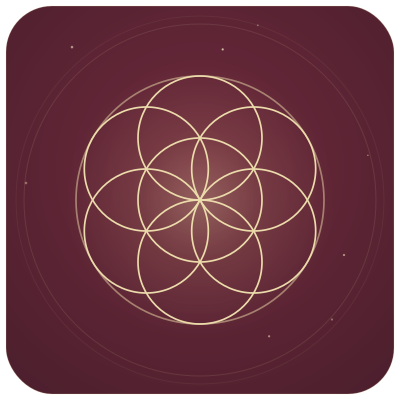

The Seed of Life is not a design anyone invented so much as a fact anyone with a compass will eventually discover. It rests on a piece of settled, uncontested geometry: the radius of a circle steps around its own circumference exactly six times. Mark a point on a circle, swing an arc of the same radius, and repeat — you will land precisely back where you started after six steps, never five, never seven. This is why six circles fit perfectly around a central seventh, why honeycomb cells are hexagonal, and why the number six governs so much of how equal circles pack in a plane.
The building block of the whole figure is the vesica piscis — the almond-shaped lens formed when two equal circles overlap so that each passes through the other's center. In classical and medieval symbolism, the vesica represented the meeting of two worlds: spirit and matter, heaven and earth, the one becoming two. The Seed of Life is simply the vesica piscis carried to completion — six overlapping unions arranged around a shared center, producing the rosette of six petals that medieval stonemasons carved into churches and folk artists across Europe painted onto barns and chests, often under names like the "sun wheel" or "rosette of the six petals."
This is worth stating plainly: the geometry here is not mystical in the sense of being unprovable. It is demonstrable, ancient, and universal. What people have made of that geometry — the meanings layered onto it — is where tradition begins and mathematics ends. Both layers are worth honoring; they should not be confused with each other.
The most enduring symbolic reading of the Seed of Life maps its seven circles onto the seven days of creation in the Book of Genesis. The first circle is the initial act — light called out of the void. Each subsequent circle, born from the intersection of what came before, represents another day of divine unfolding, until the seventh completes and rests within the whole. In this reading, the figure is a diagram of creation as process: nothing appears from nowhere; every new form emerges from the relationship between existing forms.
The number seven carries weight far beyond Genesis, of course — seven classical planets, seven days of the week, seven notes of the diatonic scale, seven chakras in yogic tradition. These correspondences are folkloric and symbolic rather than empirical, and different traditions arrived at seven for different reasons. But the convergence is part of why the Seed of Life became such a durable emblem: it gives the number a shape, and the shape a story.
There is also a quieter, more personal reading. Because the pattern begins with a single circle and grows by relationship — each new circle centered on a point created by the ones before — the Seed of Life is often taken as a meditation on how anything begins. An intention, a habit, a life's work: each starts as one small complete thing, and grows not by force but by faithful repetition from where the last effort left off.
The Seed of Life is called a seed for a reason: it is the generative core of a much larger family of figures. Continue the same compass process outward — adding circles at every new intersection — and the seven circles become nineteen, producing the famous Flower of Life, the pattern found carved and drawn at sites from Egypt to India to medieval Europe. That fuller pattern, its contested history, and its own rich symbolism deserve their own telling, and we have given them one.
Between seed and flower sit other named stages. Take the Seed of Life and add a second ring of circles in a particular way and you get the Egg of Life, an arrangement of eight spheres often likened to early embryonic cell division. Extract the centers of the completed Flower's circles, connect them with straight lines, and you arrive at the figure known as Metatron's Cube, from which the five Platonic solids can be traced. The traditional teaching frames this as a lineage: the Seed contains the Flower, the Flower contains the Fruit, and the Fruit contains the geometric alphabet of three-dimensional form. Whether one takes that lineage as metaphysics or as an elegant way of organizing geometric relationships, the progression is real on paper — each figure genuinely does emerge from the last by continuing the same simple operation.

Here the honest line matters. Popular sacred geometry writing often claims that the Seed of Life is the pattern of cell division — that a dividing embryo passes through the exact stages of the drawing. That is an overstatement. Early embryos do divide from one cell into two, four, and eight in ways that loosely resemble the Egg of Life arrangement, but biological cells are irregular, three-dimensional, and jostling; the resemblance is evocative, not exact. Treat it as poetry pointing at a real phenomenon, not as biology textbook fact.
What is solidly established is the underlying principle the Seed of Life encodes: sixfold symmetry and hexagonal packing are how nature economizes. Equal circles pressed together in a plane settle into the hexagonal arrangement because it wastes the least space — the mathematical result behind honeycomb, the arrangement of some seed heads, basalt columns cooling into hexagonal pillars, and the six arms of every snowflake. When people feel a shock of recognition looking at the Seed of Life, they are recognizing something genuinely present in the world's vibrational and structural blueprints — even if the traditional explanations for why it is present differ from the physicist's.
Because the symbol is fundamentally about beginnings, most contemporary practice with it centers on initiation — starting things well, and starting them from center. None of this replaces professional care for anything requiring it; these are contemplative practices, and their value lies in the attention and intention they organize.
If you keep a dedicated corner for reflection, the symbol sits naturally among home altar arrangements precisely because it is non-denominational: it belongs to geometry before it belongs to any single tradition.
Strip away every overlay — Genesis, chakras, embryos — and the Seed of Life still says something true. It says that completeness can be simple: seven circles, one rule, no ornament. It says that growth is relational: every new circle is centered on a point the earlier circles created together. And it says that the most elaborate structures — the Flower, the Fruit, the solids, arguably the honeycomb and the snowflake — are already implicit in the humblest beginning, waiting only for the pattern to be continued.
That is why this figure has been scratched into stone, painted onto barns, and drawn in the margins of notebooks for so long. Whatever else it may or may not be, the Seed of Life is a picture of how good things start: one small, complete circle — and then the faithful decision to draw the next one from exactly where you stand.

Sacred geometry tattoos express alignment with the patterns underlying creation — but each symbol carries its own history, meaning, and cultural weight. Here's what the major designs mean and what to weigh before the needle touches skin.

Sacred geometry meditation uses forms like the Sri Yantra, Flower of Life, and Merkaba as anchors for attention. Here are four methods — gazing, visualization, drawing, and breath pairing — and how to practice each one honestly.

Spirals in sunflowers, hexagons in honeycomb, fractals in trees and lungs — a clear-eyed field guide to where sacred geometry genuinely appears in nature, what the science confirms, and what remains beautiful folklore.