How to Find Your Life's Purpose: A Practical Framework
Holistic KingdomJune 27, 2026Updated July 13, 2026

Your life's purpose is inherently tied to your unique gifts — the talents through which you can bring the greatest benefit to the world around you. That definition has anchored this site's thinking on purpose for years, and it remains the most reliable starting point there is. Buddhists call it your dharma, your right way of living; Walt Whitman called it your verse to contribute to the play of life. But knowing the definition and finding your answer are two different tasks. This is a practical framework for the second one: the mapping method, the questions that do the digging, a statement exercise that turns insight into direction, and what to do in the seasons — like mid-life — when the compass seems to spin.
A life purpose is the through-line where your natural gifts, your deepest interests, and the needs of the world overlap — the contribution that is distinctly yours to make. It is not necessarily a job title, and it is rarely a single lightning-bolt revelation. Research on purpose consistently links a felt sense of it to better wellbeing: people with a clear sense of purpose report lower stress, greater resilience, and higher life satisfaction, and studies have found that giving yourself to a cause larger than yourself measurably improves your own wellbeing.
Two clarifications save people years of frustration. First, purpose points outward through what is most inward — it almost always involves your gifts serving something beyond you. Second, purpose is uncovered more than it is invented: the raw material is already in your history, your talents, and what you cannot stop caring about. The methods below are simply ways of removing what covers it.
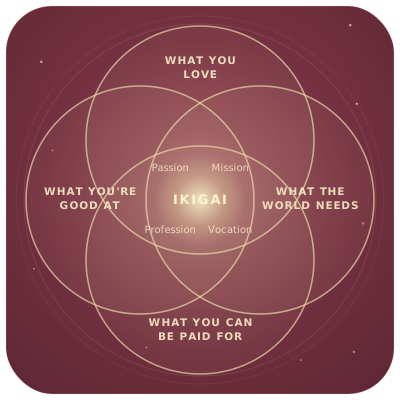
Ikigai is a Japanese word meaning, roughly, "reason for being" — and the four-circle map popularized in the West under its name is one of the most useful purpose-finding tools ever drawn. It asks you to take honest inventory in four directions:
What do you love — the activities where time disappears? What are you good at — the talents others consistently recognize in you, including the ones you discount because they come easily? What does the world need — the problems that genuinely move you? And what can you be paid for — the practical channel through which the contribution can sustain itself?
Each pairwise overlap has its own name — passion, mission, profession, vocation — and each is valuable but incomplete on its own. A passion the world doesn't need stays a hobby; a profession you don't love becomes a comfortable numbness. The center, where all four meet, is the target. Few people land there in one move; the map's real gift is showing you which circle is missing from what you're doing now, which turns a vague dissatisfaction into a specific search.
Purpose is uncovered the way a well is dug — by removing what covers it. These questions move the most earth; answer them in writing, unhurried:
Now compress what the digging surfaced into a single working sentence. Picture your life operating exactly as you would design it — you are doing, being, and contributing everything that fulfills you — and describe that scenario's essence in one statement. For example: "Inspiring and empowering myself and others to live their highest vision in a context of love and joy."
Keep it short enough to memorize and specific enough to steer by, then use it: read it in the morning, test decisions against it, and revise it as your understanding sharpens. The statement is not a contract; it is a compass heading — and writing it down matters, because a purpose that lives only as a feeling drifts, while one that lives in words can organize a week, a year, and eventually a body of work. Pairing the statement with a regular intention-setting practice keeps it from gathering dust.
The world is not short of needs — care, teaching, repair, food, community, honest information, beauty — and this is precisely where individual purpose and collective good converge: every person operating from their genuine gifts is a solution the world was missing. You don't have to address the largest problem on earth; you have to address the one that is yours, at the scale your life actually touches. For many people the fastest way to test a suspected purpose is simply to serve with it — volunteer the skill, offer the help, teach the thing — because service is purpose's native environment and community is where a rooted life pays out. The feedback is immediate: work aligned with your gifts leaves you tired and fuller; misaligned work just leaves you tired.
The compass spins hardest at the crossings — mid-life, career endings, the empty house, the recovery after loss. This is normal, and it is not evidence that you never had a purpose; it is usually evidence that a chapter's purpose has completed and the next one hasn't announced itself yet. Purpose evolves as you do.
In these seasons, three adjustments help. Work the framework again from scratch — your four circles have changed contents, and the person answering the five questions is not the person who answered them at twenty-five. Mine the previous chapters for the constant — the activity or gift that ran through every role you've loved is almost certainly coming with you into the next one. And shrink the time horizon: don't demand the next thirty years from yourself; find the purpose of this season — a year of learning, of caregiving, of rebuilding — and trust the longer arc to assemble from seasons well-lived. Attention, honestly placed on your own inner signals, is the instrument that finds the way — the same faculty explored in our field guide to the conscious mind.
One last calibration, because it protects everything above: purpose is a heading, not a verdict. People who treat it as a single fixed answer suffer twice — first in the anxious search for the "right" one, then in guilt when a true-enough answer evolves. The healthier frame is the one the old traditions always used: you are here to contribute your verse — and a verse is written line by line, revised as the poem develops. Begin with the best current answer the framework gives you, act on it at whatever scale this month allows, and let the acting refine the answer. Purpose is less something you find once than something you practice finding — and the practice itself, it turns out, is one of the most purposeful things a person can do.

Dream dictionaries promise fixed meanings, but research tells a more interesting story: common symbols cluster around shared human experiences, while their actual meaning depends on who's dreaming and why.

Dream journaling isn't general journaling with a different subject. It's a practice of catching fragile, fast-fading material before the waking mind smooths it over — and tracking it long enough to see the clusters and patterns that single dreams never reveal.

Lucid dreaming is the measurable, well-studied experience of knowing you're dreaming while still asleep. Here's what the science actually shows, how to train for it, and why protecting your sleep matters more than chasing every lucid moment.