The Sri Yantra: Nine Triangles, the Bindu, and How to Read It
Holistic KingdomSeptember 15, 2026

Ask what the Sri Yantra is, and the short answer is this: it is the most revered diagram in Hindu tantra — nine interlocking triangles radiating outward from a single central point called the bindu, framed by lotus petals, circles, and a square gate. Four triangles point upward, representing Shiva, the principle of pure consciousness; five point downward, representing Shakti, the creative energy that gives consciousness form. Where they interlace, they generate forty-three smaller triangles — a map, in the Shri Vidya tradition, of the entire process by which the unmanifest becomes the manifest. The name means "auspicious instrument" or "venerable device," and for well over a thousand years practitioners have used it exactly that way: as a device, something you work with rather than merely look at.
But a map only becomes useful when you learn to read it. And the Sri Yantra, more than perhaps any figure in the sacred geometry canon, was designed to be read — from the outside in, layer by layer, as a journey.
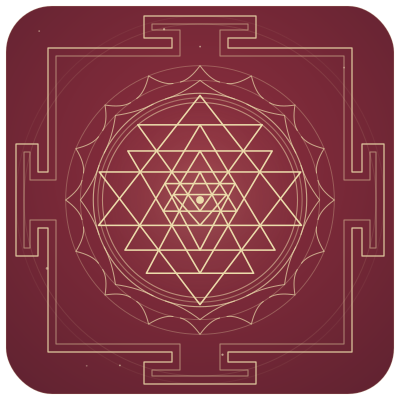

The Sri Yantra (also spelled Shri Yantra, and called the Sri Chakra when used in worship) belongs to Shri Vidya, a lineage of Hindu tantra devoted to the goddess Lalita Tripura Sundari — "the beautiful one of the three worlds." In this tradition, the yantra is not a picture of the goddess. It is the goddess, rendered in geometric form: her body, her palace, and the cosmos all at once. The celebrated devotional text Saundarya Lahari, traditionally attributed to the philosopher Adi Shankara, describes the figure's forty-three triangles as the very architecture of her dwelling.
As the Encyclopaedia Britannica notes, yantras in general function within tantra as instruments of concentration and ritual — geometric supports for practices that would otherwise remain abstract. The Sri Yantra is considered the summit of this genre, sometimes called the yantra raja, the king of yantras. Carved stone versions survive in Indian temples dating back centuries; the figure appears in three main physical forms, from flat drawings (bhu prastara) to fully three-dimensional pyramidal versions (Meru prastara) that raise the layers into a mountain, with the bindu at the peak.
This is worth stating plainly: the meanings attached to the Sri Yantra are theological and traditional, not scientific claims. What the tradition offers is a coherent symbolic system, refined over many centuries, for contemplating how unity becomes multiplicity — and how attention might travel back the other way.
The geometric heart of the figure is deceptively simple to describe and famously difficult to draw. Nine large triangles share a common center: four apex-up (the Shiva triangles), five apex-down (the Shakti triangles). Their overlapping edges must intersect cleanly — in the classical construction, multiple lines are required to pass through single shared points, a condition called concurrency. Get one triangle's proportions slightly wrong and the errors cascade outward through the whole lattice.
This is not a trivial drafting problem. Mathematicians who have analyzed the figure — notably the Russian researcher Alexey Kulaichev in the 1980s — concluded that a perfectly concurrent Sri Yantra cannot be constructed with ruler and compass alone in any obvious way, and that traditional methods must have relied on sophisticated iterative approximation. Whoever first perfected the figure was doing serious geometry, whatever else they were doing. The interlacing produces forty-three visible triangles arranged in concentric rings: a central triangle, then rings of eight, ten, ten, and fourteen. In Shri Vidya, each ring is an avarana — an enclosure or veil — and each of the forty-three cells houses a named aspect of the goddess.
The symbolism of the interlock rewards a moment's attention. Neither set of triangles is complete without the other; consciousness without energy is inert, energy without consciousness is blind. The entire figure exists only in their union — a theme the Sri Yantra shares with other union-geometries like the Merkaba's counter-rotating tetrahedrons, though the two come from entirely different traditions and shouldn't be conflated.

At the exact center sits a single point: the bindu. In Shri Vidya cosmology, this is the seed of all manifestation — the dimensionless origin from which the nine triangles, and by extension the entire universe, unfold. It is often described as the point of union itself, where Shiva and Shakti are not yet two.
The bindu gives the yantra its double directionality, and this is the key to reading it. Traced from the center outward (srishti krama, the order of creation), the figure narrates emanation: one point becoming triangles, triangles becoming lotuses, lotuses becoming the walled square of the material world. Traced from the outside inward (samhara krama, the order of dissolution), it becomes a contemplative itinerary — the practitioner's attention withdrawing from the outer world, passing through each enclosure, and finally resting in the point where multiplicity collapses back into unity. The same diagram is simultaneously a cosmology and a meditation manual, depending on which way you travel.
Traditional worship of the Sri Chakra moves through nine enclosures, each with a Sanskrit name describing what it accomplishes. Reading them in sequence — outermost first — is the classical way to understand the figure:
You don't need to memorize the Sanskrit to use the structure. The pattern underneath is what matters: gross to subtle, outer world to inner faculties to vital energies to pure awareness. It is a staircase, drawn flat.
Honesty requires separating three layers. The geometry is real and genuinely remarkable — the concurrency problem is documented in the mathematical literature, and the figure's construction history is a legitimate puzzle in the history of science. The tradition is real — Shri Vidya is a living lineage with a sophisticated contemplative system built around this diagram. The popular claims are where caution belongs: assertions that the Sri Yantra emits measurable energy, alters brainwaves in specific ways, or attracts wealth are not supported by rigorous, replicated research. A handful of small studies on yantra-focused concentration exist, but nothing that distinguishes the Sri Yantra's effects from those of focused attention on any complex, symmetrical image.
That said, focused attention on a complex, symmetrical image is itself a well-established meditative technique. Visual concentration practices — trataka in the yogic vocabulary — train the same attentional stability that any meditation method cultivates, and steady single-pointed focus is among the best-studied contemplative skills. The yantra doesn't need paranormal properties to be useful. It needs your eyes and twenty minutes.
Traditional Sri Chakra puja is elaborate, mantra-driven, and typically learned from a teacher within the lineage — worth respecting rather than improvising. But a simplified contemplative approach is widely practiced and accessible to anyone. Sit comfortably with a printed or drawn yantra at eye level, about arm's length away, in soft even light. Rest your gaze on the bindu without straining. When the eyes tire or the mind wanders, let your attention travel slowly outward through the rings — triangles, lotuses, square — then walk it back in, enclosure by enclosure, until it settles on the center again. That inward walk is the samhara krama in miniature. Ten to twenty minutes is plenty; pairing the practice with a clear intention gives the session a spine.
Some people keep a Sri Yantra in a meditation corner or on a home altar, oriented with the bindu at eye level when seated. Treat it the way the tradition does — as an instrument kept for use, not an ornament — and it earns its place.
The Sri Yantra endures because it does something few symbols manage: it gives the eye a road. Most sacred images ask you to look at them. This one asks you to travel — out from the point where everything begins, and back again, until the map and the territory quietly become the same thing.

Sacred geometry tattoos express alignment with the patterns underlying creation — but each symbol carries its own history, meaning, and cultural weight. Here's what the major designs mean and what to weigh before the needle touches skin.

Sacred geometry meditation uses forms like the Sri Yantra, Flower of Life, and Merkaba as anchors for attention. Here are four methods — gazing, visualization, drawing, and breath pairing — and how to practice each one honestly.

Spirals in sunflowers, hexagons in honeycomb, fractals in trees and lungs — a clear-eyed field guide to where sacred geometry genuinely appears in nature, what the science confirms, and what remains beautiful folklore.