The Tetrahedron: Fire, Stability, and the Simplest Solid
Holistic KingdomNovember 1, 2026

The tetrahedron is the simplest three-dimensional shape that can exist: four triangular faces, four vertices, six edges, and no way to remove a single face without the whole structure collapsing into a flat plane. In sacred geometry, it is assigned to the element of fire, a pairing Plato made explicit more than two thousand years ago and one that still holds up reasonably well when you look at how the shape actually behaves — sharp-pointed, directionally aggressive, and structurally restless compared to its rounder Platonic siblings. It is also, by most readings, the foundational form: the shape from which the other four Platonic solids are said to be built, and the one that shows up first when you trace the construction lines of Metatron's Cube or the interlocking structure of the merkaba.
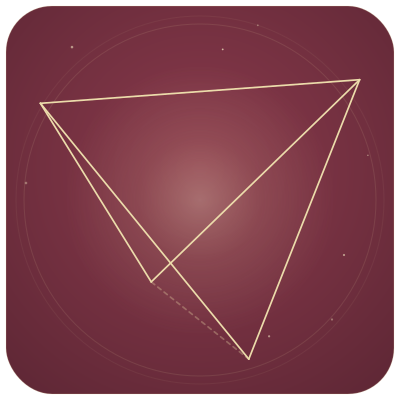
That's the short answer. The longer one involves actual geometry, actual materials science, a few thousand years of philosophical reasoning about what matter is made of, and a modern engineering tradition that took the ancient instinct about fire and stability and turned it into something you can build a bridge with. You can see the shape's full construction in the tetrahedron diagram built alongside this piece — four equilateral triangles folded into the tightest possible enclosure of space.
A tetrahedron needs exactly four points to exist in three dimensions, and that is the mathematical minimum. Three points define a flat triangle; add a fourth point off that plane and you get volume for the first time. Every other Platonic solid — the cube, octahedron, dodecahedron, icosahedron — requires more vertices to close itself off. This is why the tetrahedron is sometimes called the atom of 3D geometry: it is irreducible, the smallest unit from which more complex enclosed volumes can be assembled.
It is also self-dual, a property worth sitting with for a moment. If you take the center point of each face of a cube and connect those points, you get an octahedron — the cube and octahedron are duals of each other. Do the same operation to a tetrahedron, though, and you get another tetrahedron, just smaller and inverted. It turns itself inside out and remains itself. No other Platonic solid does this. Geometers read this as a kind of self-sufficiency; esoteric traditions have tended to read it as a symbol of singular, undivided identity — a shape that doesn't require a partner to complete its own logic, unlike the cube-octahedron or dodecahedron-icosahedron pairs. The full lineup of these five shapes, and how they relate to one another elementally, is covered in more depth in the Platonic solids overview; this piece stays with the tetrahedron alone.
In the dialogue Timaeus, Plato laid out a cosmology in which the four classical elements were not just philosophical categories but literal geometric solids, small enough to be imperceptible but real enough to compose everything in the physical world. Earth was the cube, stable and stackable. Water was the icosahedron, the roundest and most mobile of the solids, able to roll and flow. Air was the octahedron, light and spinning. And fire was the tetrahedron — the sharpest, most pointed, least stable of the group, with the fewest faces and the most acute angles.
Plato's reasoning, as far as it survives, was almost tactile. Fire feels sharp; it pricks and burns on contact, so its particle should be the shape with the sharpest points. Fire is also the least substantial of the elements, easiest to break apart and hardest to pin down, so its solid should be the one that encloses the least volume relative to its surface area — which the tetrahedron does, more than any other Platonic solid. This was never meant as empirical chemistry. It was a reasoned analogy built centuries before atomic theory existed, and it should be read as the product of careful observation filtered through the tools available at the time, not as a scientific claim that holds up under a microscope. What it does hold up as is a remarkably consistent symbolic system, and that internal consistency is part of why it has persisted. The broader context for how these elemental-shape pairings sit within the wider tradition is addressed in the sacred geometry overview, which traces the pattern language this all belongs to.

Set the symbolism aside for a moment, because there is a genuinely settled piece of physics underneath the tetrahedron's reputation for stability, and it has nothing to do with mysticism. A triangle is the only polygon that cannot change shape without changing the length of one of its sides. A square can be pushed into a parallelogram while every side stays the same length; a triangle, once its three side lengths are fixed, is rigid. There is only one triangle those three lengths can make.
The tetrahedron is the three-dimensional extension of that principle — a solid built entirely out of triangular faces, which makes it the most structurally rigid enclosed shape that exists. This is not folklore. It's the reason truss bridges, radio towers, and spaceframe structures are built from triangulated members rather than rectangular ones, and it's the reason the architect and inventor Buckminster Fuller spent much of his career advocating for tetrahedral and octet-truss construction, arguing that triangulated geometry did more structural work with less material than any other framing system. A few practical implications of this principle:
This engineering reality is probably the single best argument for why ancient thinkers landed on the tetrahedron as a symbol of structural fire and raw dynamism rather than calm permanence — it is stable in the sense of being rigid and resistant to collapse, but it is not stable in the sense of being restful. It wants to move.
In most traditions that inherited or paralleled Plato's framework, fire was never only about combustion. It stood for transformation, will, digestion in the literal and metaphorical sense, and the catalytic force that converts one state of matter or being into another. Assigning that symbolic territory to the sharpest, most volatile of the Platonic solids made intuitive sense long before anyone could explain triangulated rigidity in engineering terms.
This is also where the tetrahedron shows up most often in contemporary spiritual practice: as a focal object for intentions around willpower, drive, ambition, and the kind of personal ignition that gets a stalled project or a stalled life moving again. It's worth being clear-eyed here — there is no evidence that visualizing or handling a tetrahedral object produces a measurable physiological or energetic effect. What the practice offers is a concentration device, similar in function to how any consistent visual anchor supports focus during sacred geometry meditation: a clean, specific form to hold attention steady while setting an intention, not a mechanism with its own independent power.
Two tetrahedra of equal size, interpenetrated so that one points up and one points down, form a shape often called the star tetrahedron or stellated octahedron. This compound is frequently discussed alongside — and sometimes conflated with — the merkaba, the three-dimensional meditation and visualization symbol built from the same two interlocking tetrahedra. The distinction matters: the star tetrahedron is the geometric compound itself, a fixed structure with a formal mathematical definition, while the merkaba carries an additional layer of symbolic and practiced meaning tied to specific visualization traditions around the body, spirit, and movement through dimensional space. The full treatment of that practice, its origins, and how it's used in meditation lives in the merkaba guide; it's worth understanding the single tetrahedron first, since the compound form is built from two of them working in opposition.
People who incorporate the tetrahedron into ritual or reflective practice tend to use it in a handful of consistent ways: as a physical object (crystal tetrahedra, often in fire-associated stones like carnelian or citrine, are common), as a drawn or visualized form during meditation, or as a structural motif in altar arrangements meant to represent the fire element alongside water, earth, and air counterparts. None of this requires belief in any literal energetic property of the shape to be worthwhile — the value, as with most sacred geometry practice, is in the focusing ritual itself, the deliberate act of choosing a form and sitting with what it represents.
The honest caveat applies here as it does everywhere in this field: the tetrahedron's elemental and symbolic associations are a philosophical and artistic inheritance, not a verified mechanism, and they're worth engaging with as exactly that — a old and remarkably coherent way of thinking about structure, transformation, and the minimum conditions required for something to exist at all. Held that way, the simplest solid turns out to have quite a lot to say.

The dodecahedron is the fifth and final Platonic solid, built from twelve golden-ratio pentagons, and the one Plato reserved not for an earthly element but for ether itself, the substance of the cosmos.

The octahedron's eight triangular faces have stood for air, balance, and integration since Plato's Timaeus — and the same shape turns up, unprompted, in diamond and fluorite crystal lattices. Here's what the geometry actually says.

The torus is a donut-shaped form that loops back on itself, found in magnetic fields, vortex rings, and planetary dynamics. Here's what's measured science, what's metaphysical claim, and where the torus's meaning comes from in sacred geometry.