The Dodecahedron: Ether, the Cosmos, and Plato’s Fifth Solid
Holistic KingdomNovember 2, 2026

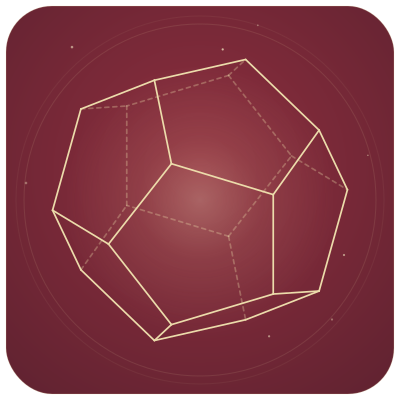
If you've landed here wondering what the dodecahedron actually means, the short answer is this: it's the fifth and final Platonic solid, built from twelve regular pentagons, and in the sacred geometry tradition it stands for the cosmos as a whole, the element Plato called ether, and the idea that creation itself has a shape. Where the other four Platonic solids were mapped by the ancient Greeks onto earth, water, air, and fire, the dodecahedron was reserved for something larger than any single element. Plato described it in the Timaeus as the form the gods used to arrange the constellations across the heavens, the geometry of the universe's outer container. It's a twelve-faced, twenty-vertex, thirty-edge solid, and depending on who you ask, it's either a mathematical curiosity with an unusually elegant relationship to the golden ratio, or the closest thing geometry offers to a blueprint of everything.
Both things can be true at once, and that tension is really the story of this shape. The dodecahedron sits at the exact point where rigorous mathematics and ancient cosmological speculation overlap, and untangling the two is worth doing properly rather than collapsing one into the other. This piece covers that ground: what makes the dodecahedron Platonic in the first place, why Plato singled it out for ether, how it relates to its geometric twin the icosahedron, and where modern physics has, surprisingly, circled back to a dodecahedral idea of its own.
A Platonic solid has to meet a short, strict list of requirements: every face must be an identical regular polygon, every vertex must have the same number of faces meeting at it, and the whole thing has to be convex, with no dents or irregularities. Only five shapes in the entire universe of three-dimensional geometry satisfy that constraint, which is itself a mathematically proven fact, not a tradition or a belief. The sacred geometry pillar on this site covers all five in context, but the dodecahedron is the one built from pentagons rather than triangles or squares, and that single choice changes everything about how it behaves.
Twelve pentagonal faces meet three at a time at each of twenty vertices, generating thirty edges in total. It's the most complex of the five solids by vertex count and the only one whose faces aren't triangles, squares, or a single repeated simple shape without an embedded ratio. That pentagonal face is exactly why the ancient world found the dodecahedron so compelling, and exactly why it earned a cosmic assignment the other four didn't get.

Every regular pentagon has the golden ratio, phi, baked into its proportions: the ratio of a diagonal to a side is exactly phi, and the five diagonals of a pentagon form a smaller pentagon inside, which generates a pentagram, which generates another pentagon, recursively, forever. The dodecahedron inherits all of that. Its volume, surface area, and the relationships between its edges and the sphere that circumscribes it are all expressible in terms of phi, which is part of why Pythagorean and later Platonic thinkers treated the shape as something closer to a mathematical revelation than an arbitrary solid.
The deeper mechanics of that ratio, why it shows up in pinecones and spiral galaxies and human proportion, are covered at length in the golden ratio piece on this site, and that context is worth reading alongside this one. What matters here is narrower: the dodecahedron isn't just one of five possible symmetrical solids, it's the one where phi stops being a side detail and becomes structural. That's a mathematically settled fact, not an interpretation.
In the Timaeus, written around 360 BCE, Plato assigns the tetrahedron to fire, the cube to earth, the octahedron to air, and the icosahedron to water, reasoning from each shape's relative sharpness, stability, and mobility. The dodecahedron doesn't fit that pattern of tactile elements, and Plato treats it differently: he writes that the god used this form for arranging the whole heaven, embroidering it with constellations. Later Pythagorean and Platonic commentators formalized this into a fifth element, aether or quintessence, understood as the substance filling the celestial realm beyond earth, air, fire, and water, the medium of the stars themselves.
This is where the historical record needs to be stated plainly: there is no empirical ether. The concept was a philosophical placeholder, later adopted into physics as a hypothetical medium for light transmission, and it was decisively ruled out by the Michelson-Morley experiment in 1887 and the development of special relativity shortly after. What survives isn't the physics but the symbolism, and it's a durable one. In sacred geometry and esoteric traditions, the dodecahedron continues to represent the cosmos as totality, consciousness itself, or the container that holds the other four elements together, a reading that shows up repeatedly in the broader sacred geometry framework this site maps out.
Every Platonic solid has a dual, a partner shape formed by connecting the center points of its faces, and the dodecahedron's dual is the icosahedron. Take a dodecahedron's twelve pentagonal face-centers, connect them, and a twenty-faced triangular solid emerges; run the process in reverse and the dodecahedron reappears. This isn't symbolic license, it's geometric fact, and it's why the two shapes are so often discussed as a pair rather than in isolation.
Symbolically, traditions that assign the icosahedron to water and the dodecahedron to ether or spirit treat this pairing as a relationship between the material and the transcendent, the fluid and the fixed, the body of the world and its outer frame. The full mechanics of the icosahedron and how all five solids relate to each other elementally are covered in the icosahedron and Platonic solids guide, which is worth reading as a companion to this one rather than a repeat of it.
Long before Plato wrote the Timaeus, the Pythagoreans are believed to have studied the five regular solids, and ancient sources claim the dodecahedron carried particular weight in their closed community, sometimes framed as a symbol so significant that revealing its construction to outsiders was treated as a serious transgression. How much of that is historical fact versus later embellishment is genuinely unclear, and it's worth saying so rather than repeating it as settled history.
What is physically documented is stranger and less explained. Archaeologists have recovered more than a hundred small bronze dodecahedra from Roman-era sites across Europe, dating roughly from the second to fourth centuries CE, each with circular holes of varying diameters in its twelve faces and knobbed vertices. No ancient text describes their purpose, and no inscription has ever been found on one. Proposed uses range from surveying tools and candle holders to religious objects and knitting gauges, and the honest state of the evidence is that nobody knows. It's one of the rare cases in archaeology where a Platonic solid shows up as a real, physical, mass-produced artifact, and the mystery around it has outlasted every theory offered to solve it.
Here the story takes an unexpected modern turn. In 2003, a team led by cosmologist Jean-Pierre Luminet proposed, in a study published in the journal Nature, that the overall shape of the universe might be a Poincaré dodecahedral space, a finite, curved topology built from a dodecahedron with opposite faces mathematically glued together. The idea emerged from anomalies in the cosmic microwave background data collected by NASA's WMAP satellite, specifically a weaker-than-expected signal at the largest observable scales, which a dodecahedral topology could help explain.
This is a real, peer-reviewed cosmological hypothesis, not folklore dressed up as science, but it remains genuinely unresolved. Subsequent data releases from the Planck satellite have both supported and complicated the original anomaly, and the broader cosmology community has not converged on the dodecahedral model as the leading explanation for the universe's shape. It's fair to describe this as an open, actively debated question rather than a confirmed finding, and it's worth holding that honestly rather than treating a provocative headline from 2003 as settled cosmic fact. Still, it's a striking coincidence that the shape Plato assigned to the heavens two and a half thousand years ago keeps resurfacing, independently, in the mathematics of modern physics.
None of the above requires belief to be useful as a contemplative tool. A regular form with twelve faces, each itself built from phi, gives the eye and the mind a genuinely complex structure to settle into, which is part of why dodecahedral imagery shows up across meditation practice, home altars, and geometric art.
Approached this way, the dodecahedron isn't a claim about physics or cosmology, it's a focal point, the same role any well-proportioned form can play in a quiet practice. That's a modest claim, and it's the honest one.
The dodecahedron earns its reputation honestly: it's a mathematically rare, provably exact shape that ancient thinkers reached for when they needed a symbol large enough to hold the whole sky, and a shape modern physicists have, independently, reached for again. Whether or not the universe turns out to be dodecahedral, the twelve-faced solid remains a genuinely rich meeting point of geometry, history, and the old human instinct to look for pattern in everything, including the heavens themselves.

The octahedron's eight triangular faces have stood for air, balance, and integration since Plato's Timaeus — and the same shape turns up, unprompted, in diamond and fluorite crystal lattices. Here's what the geometry actually says.

Four triangular faces, the fewest vertices possible, and a reputation for both fire and structural rigidity — the tetrahedron is where Platonic geometry gets its sharpest edges. Here's what's settled science and what's symbolic inheritance.

The torus is a donut-shaped form that loops back on itself, found in magnetic fields, vortex rings, and planetary dynamics. Here's what's measured science, what's metaphysical claim, and where the torus's meaning comes from in sacred geometry.