The Egg of Life: Eight Spheres and the Shape of Early Growth
Holistic KingdomOctober 31, 2026

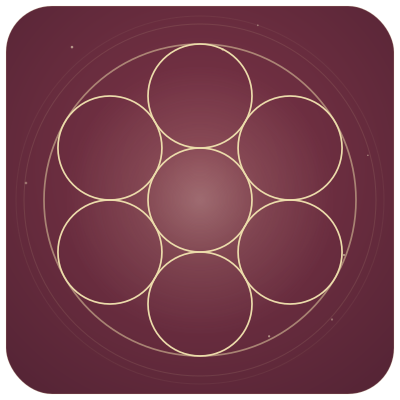
The Egg of Life is a sacred geometry figure made of eight circles arranged in two offset rows of four, overlapping just enough that the whole cluster reads as a single rounded form rather than eight separate shapes. It's drawn from the same grid that produces the Seed of Life and the Flower of Life, but it isolates a different subset of circles and strips away the connecting arcs, leaving clean, sphere-like outlines instead of the lattice of overlapping lines those other two symbols are known for. Visually, it looks like a cluster of eggs in a carton tilted on its side, or like bubbles pressed together at the surface of a pond. That resemblance is the source of the name, and it's also why the figure has become shorthand, in sacred geometry circles, for cellular growth, gestation, and the earliest architecture of living things.
The meaning attached to the Egg of Life rests on three separate claims, and it's worth pulling them apart early. The geometric claim — that eight circles can be packed this way, and that the pattern sits inside the larger Flower of Life matrix — is simply true and can be verified with a compass and straightedge. The symbolic claim — that this packing represents beginnings, growth, and the structure underlying new life — is a tradition, carried forward by generations of geometers and mystics, and it deserves to be read as exactly that: a meaningful human interpretation, not a scientific finding. The biological claim — that the shape mirrors actual embryonic cell division — is where things get more complicated, and where the honest answer is "partially, and only for a very short window." The sections below take each of these in turn, starting with the geometry itself, which you can see worked out in the hand-drawn diagram accompanying this piece.

Construction starts the same way every circle-based sacred geometry figure does: with a vesica piscis, the lens shape formed when two circles of equal radius overlap so that each circle's edge passes through the other's center. From there, the Seed of Life emerges as six circles drawn around a central seventh, each overlapping its neighbors by exactly that same vesica relationship. The Egg of Life takes a different slice of the same underlying grid. Instead of six circles radiating symmetrically around one center, it uses eight circles arranged in two parallel rows of four, each row shifted half a circle-width relative to the other, so that every circle nestles into the gap left by its neighbors above or below.
The result is a shape with a rough oval silhouette, wider in the middle and tapering slightly at both ends, which is how the figure earns its name rather than through any literal resemblance to a bird's egg. Because the circles overlap in a brick-like, nested pattern rather than a radial one, the Egg of Life reads less like a mandala and more like a packed cluster, which turns out to matter for how it's usually interpreted.
Flat circle diagrams in sacred geometry are almost always shorthand for sphere-packing problems, and the Egg of Life is a clear example. If each circle in the drawing is understood as the equatorial cross-section of a sphere, the two-row, offset arrangement is exactly how equal-sized spheres settle when they're packed as tightly as possible — the same configuration you'd see in a tray of oranges stacked so each piece sits in the hollow formed by the layer beneath it. This is called close packing, and it shows up constantly in the physical world, from the arrangement of atoms in a metal crystal to the way soap bubbles arrange themselves at a sink's surface, a pattern explored more broadly in Vibrational Blueprints of the Natural World.
Some teachers who work with the Egg of Life describe an eighth, hidden sphere sitting directly behind the center of the cluster, invisible in the flat drawing but implied by the three-dimensional geometry — read symbolically as the unseen organizing principle behind visible growth. This is a traditional gloss rather than a mathematical necessity; the eight visible circles in the standard drawing already complete the figure without requiring a hidden ninth element. It's worth knowing the claim exists, and worth knowing it's interpretive rather than structural.
The most common explanation offered for the Egg of Life's meaning ties it to the early stages of embryonic development. A fertilized human egg divides into two cells, then four, then eight, over the first few days following conception — a well-documented process called cleavage, and the eight-cell stage is a real, clinically significant milestone in reproductive medicine, used as a benchmark in IVF embryo grading. The visual appeal is obvious: eight round cells clustered together do, for a brief window, resemble a packed sphere arrangement not unlike the Egg of Life diagram.
Where the comparison gets shaky is in the specifics. Actual blastomeres — the cells formed during these early divisions — aren't fixed in a rigid geometric lattice; they're soft, irregularly shaped, and shift position as the embryo compacts and begins forming the more organized structure of a blastocyst within about five days. The eight-cell stage is a real biological milestone, but the precise, symmetrical, two-rows-of-four geometry of the Egg of Life is a human drawing convention, not a direct snapshot of what an embryologist sees under a microscope. The honest framing is that the symbol gestures at a genuine biological process — cells dividing in doubling sequences, spheres packing efficiently — without being a literal diagram of it. Sacred geometry traditions have always worked this way: noticing a real pattern in nature, then building an idealized, simplified version of it to meditate on.
Outside the embryology comparison, the Egg of Life carries meanings drawn from older, more folkloric associations. Some lineages connect it to Druidic and Celtic symbolism around fertility and the turning of seasons, pairing it conceptually with themes explored in Solstices, Equinoxes, and the Wheel of the Year. Others have mapped the eight circles onto the eight notes of a musical octave, suggesting the shape encodes a harmonic structure the way Pythagorean geometry linked ratio to sound — an evocative idea, but one without rigorous support, and best held loosely as folklore rather than established correspondence.
What's consistent across traditions is less the specific symbolism and more the underlying instinct: that a shape built from the simplest possible repeating unit — the circle — can stand in for the beginning of something larger. That instinct runs through the whole lineage of circle-based sacred geometry, from the Vesica Piscis through the Seed of Life and into the fully bloomed Flower of Life, each stage read as a step further into complexity and manifestation.
People who incorporate the Egg of Life into a personal practice tend to use it less as an object of study and more as a visual anchor — something to look at or hold in mind while working through a transition, a new beginning, or a period of literal or figurative gestation.
None of these practices require believing the geometry is a literal map of biology. They work, to the extent they work, the same way any contemplative object works: by giving attention somewhere steady to land.
Circles within circles have carried this kind of meaning for thousands of years, long before anyone had a microscope to check the biology against the drawing. The Egg of Life sits comfortably in that lineage — not as a scientific diagram, but as a very old habit of mind: looking at the simplest possible shape and asking what it might be trying to tell us about how things begin. For a broader look at how this particular shape fits among its relatives, the Sacred Geometry Symbols and Meanings overview is a good next stop.

The dodecahedron is the fifth and final Platonic solid, built from twelve golden-ratio pentagons, and the one Plato reserved not for an earthly element but for ether itself, the substance of the cosmos.

The octahedron's eight triangular faces have stood for air, balance, and integration since Plato's Timaeus — and the same shape turns up, unprompted, in diamond and fluorite crystal lattices. Here's what the geometry actually says.

Four triangular faces, the fewest vertices possible, and a reputation for both fire and structural rigidity — the tetrahedron is where Platonic geometry gets its sharpest edges. Here's what's settled science and what's symbolic inheritance.