The Octahedron: Air, Balance, and the Shape of Integration
Holistic KingdomNovember 1, 2026

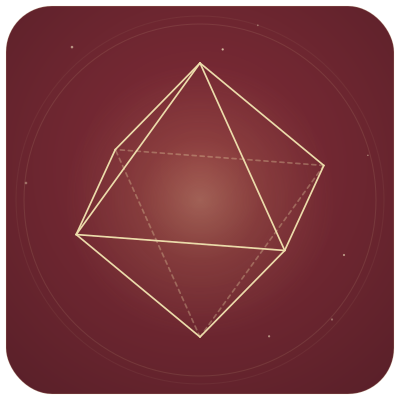
The octahedron is one of five Platonic solids: an eight-faced shape made of equilateral triangles, formed essentially by joining two square-based pyramids at their base. In sacred geometry, it's assigned to the element of air, and it carries meanings of balance, integration, and reflection — the shape that sits at the exact midpoint of the solid world, touching extremes on either side without belonging fully to either. If you look at the hand-drawn form at /symbols/octahedron.svg, the symmetry is immediately obvious: a top point, a bottom point, and a horizontal band of four vertices around the middle, like two tents pitched base to base. That visual balance is not decorative. It's the entire reason the shape has carried the meanings it has for roughly 2,400 years.
Understanding why this particular arrangement of eight triangles became associated with air, equilibrium, and the heart requires looking at both the math and the mythology that grew around it — and the octahedron rewards that kind of close look more than almost any other solid in the set, because its structure genuinely does behave differently from its four Platonic siblings.
{{image:octahedron_structure}}
An octahedron has eight triangular faces, twelve edges, and six vertices. Every face is an identical equilateral triangle, every vertex is where four faces meet, and the whole form is perfectly regular, meaning it can be inscribed in a sphere that touches every corner at equal distance from the center. That regularity is what qualifies it as one of the five true Platonic solids in the first place — only five shapes in three-dimensional space can be built entirely from one repeating regular polygon with identical angles at every vertex.
The octahedron has a second property that makes it mathematically distinctive: it is the dual of the cube. If you take a cube and place a point at the center of each of its six faces, then connect those points, the shape that emerges is an octahedron. Run the process in reverse — place a point at the center of each of the octahedron's eight faces and connect those — and the cube reappears. The two shapes are, geometrically speaking, mirror reflections of each other's structure, which is part of why earth and air were paired as elemental opposites that somehow still define each other.
In the dialogue Timaeus, Plato laid out a system matching four of the five solids to the four classical elements, reasoning from the felt qualities of each shape. The tetrahedron, sharp and compact, was fire. The cube, stable and square-set, was earth. The icosahedron, built from twenty faces and rolling almost like a sphere, was water. The octahedron, light, symmetrical, and seemingly suspended in balance between its two points, was air.
The reasoning was intuitive rather than empirical — Plato was working from the sensation each form evokes rather than any physical property air actually has. He described the octahedron as the most mobile and least substantial-feeling of the solids after the tetrahedron, a shape that seems to hover rather than sit. Whether or not that association holds up as physics, it has held up remarkably well as metaphor, which is really the register sacred geometry operates in. The parent overview of sacred geometry symbols and meanings covers how this elemental mapping fits into the broader five-solid system; here, the focus stays on what makes air's shape distinct.
{{image:octahedron_crystal_nature}}
Unlike some sacred geometric claims, the octahedron's recurrence in the physical world is not folklore — it is measurable crystallography. Several naturally occurring minerals crystallize in octahedral habit, meaning their atomic lattice literally grows into this eight-faced form:
This is a case where ancient symbolic intuition and modern physical science happen to converge on the same shape, even though they arrived by entirely different routes — one through philosophical reasoning about elements, the other through X-ray crystallography centuries later.
In contemplative traditions that work with Platonic solids, the octahedron is most often tied to equilibrium and the heart. The reasoning draws on its structure: a point reaching upward, a point reaching downward, and a stable band of four vertices holding the middle — read symbolically as spirit above, matter below, and a balancing field of integration where the two meet. That middle band is often associated with the heart chakra, framed as the point in the body's energetic system where the lower, more physical centers and the upper, more subtle ones are said to reconcile.
This is a symbolic and traditional framing rather than a scientific claim about anatomy or energy, and it's worth naming that plainly. There is no evidence that a crystal's crystal habit or a geometric diagram directly affects the body's chakra system, which itself is a concept from specific contemplative traditions rather than an empirically established anatomical structure. What the tradition offers instead is a coherent metaphor: air as breath, breath as the thing that links body and mind, and the octahedron as the geometric shorthand for that linking function. People who work with sacred geometry in meditation often choose the octahedron specifically during periods of transition or when trying to reconcile two conflicting parts of a decision, treating the shape as a visual anchor for that intention rather than a mechanism of change.
Seen on its own, the octahedron is just an elegant solid. Seen alongside its four siblings, its role in the full system becomes clearer — each shape handling a different register of experience, from the grounded to the expansive. The complete set, including the icosahedron and the other Platonic solids, maps onto the classical elements as follows:
The octahedron's position in the middle of this list is not incidental to how practitioners talk about it. It sits numerically and symbolically between fire's four faces and water's twenty, a literal midpoint that reinforces the balance theme running through every other association made with the shape.
Practically, people engage with the octahedron in a few recurring ways: as a meditation focus held in the mind's eye or drawn out by hand, as a physical object (crystal or modeled solid) placed on an altar or desk during periods of decision-making, and as a component within more elaborate diagrams like Metatron's Cube, which contains all five Platonic solids encoded within its lines, the octahedron among them. None of these practices carry a claim of physical effect beyond what focused attention and ritual structure can offer psychologically — a point worth being direct about given how often geometric objects get marketed as having inherent energetic properties they haven't been shown to possess.
What the practices do offer, consistently, is a point of focus for the specific intention of balance: breathing exercises paired with visualizing the shape's two opposing points, journaling prompts framed around where in life equilibrium feels absent, or simply tracing the form by hand as a way of settling attention before a harder conversation or decision. Readers looking to build a broader practice around these shapes can find structured approaches in guides to using sacred geometry in meditation, which treat the octahedron as one tool among several rather than a singular solution.
The octahedron's appeal, in the end, rests on something almost disarmingly simple: it looks like what it means. Two points reaching in opposite directions, held together by a stable ring in between — a shape that doesn't need much interpretation to communicate balance, because balance is exactly what its structure performs. Whether that resonance comes from Plato's original intuition, from diamond's quiet insistence on growing into exactly this form, or from something harder to name, the octahedron has earned its long tenure in sacred geometry by being, geometrically speaking, honest about what it represents.

The dodecahedron is the fifth and final Platonic solid, built from twelve golden-ratio pentagons, and the one Plato reserved not for an earthly element but for ether itself, the substance of the cosmos.

Four triangular faces, the fewest vertices possible, and a reputation for both fire and structural rigidity — the tetrahedron is where Platonic geometry gets its sharpest edges. Here's what's settled science and what's symbolic inheritance.

The torus is a donut-shaped form that loops back on itself, found in magnetic fields, vortex rings, and planetary dynamics. Here's what's measured science, what's metaphysical claim, and where the torus's meaning comes from in sacred geometry.