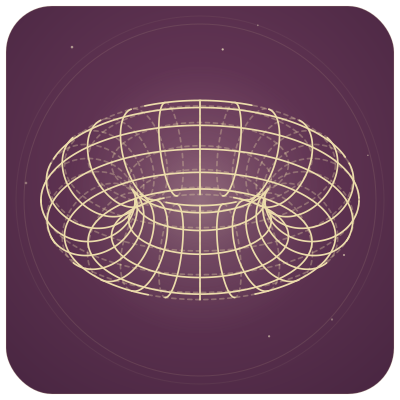
The Torus: The Self-Sustaining Shape of Energy Flow
Holistic KingdomOctober 31, 2026

If you've ever cut an apple in half the wrong way, or watched a smoke ring drift sideways across a room, you've already seen a torus. A torus is the shape of a thing that circulates — it moves outward, curves back on itself, and reenters through its own center, over and over, without needing anything outside itself to keep it going. Geometrically, it's a donut: a ring formed by rotating a circle around an axis that doesn't pass through the circle itself. Energetically, it's become one of the most talked-about shapes in sacred geometry because that same looping, self-feeding structure appears to show up everywhere from magnetic fields to the human body's biofield — some of it measured, some of it inferred, and some of it belief dressed up as physics.
This piece sorts out what's actually documented about toroidal flow, what the sacred geometry tradition claims about it, and where the line between the two sits. The hand-drawn glyph at /symbols/torus.svg is worth having open while you read, since the shape is genuinely easier to understand by looking at it than by reading a definition.
In pure mathematics, a torus is a surface of revolution — take a circle, pick a line in the same plane that doesn't touch it, and spin the circle around that line. The result is a ring-shaped surface with a hole through the middle. Topologists care about the torus because it has a different fundamental structure than a sphere: a sphere can be shrunk to a point without tearing, but a torus can't, because of that hole. This isn't mystical language; it's a standard distinction taught in any introductory topology course, and it's part of why the torus shows up as a foundational shape in fields as unrelated to spirituality as string theory and donut-shaped tokamak reactors used in fusion research.
What makes the torus distinct from other shapes discussed in sacred geometry — the sphere, the cube, the shapes catalogued alongside the icosahedron and the other Platonic solids — is that it isn't just a static form. It describes a flow pattern: energy or matter moving outward from a central axis, curving around the outside, and returning to feed back through the center. That return path is the part people find meaningful, because it describes a closed loop rather than a one-way dissipation.

This is the part that's genuinely well-documented, separate from any metaphysical reading. Toroidal structures recur across scales because the geometry is simply an efficient, stable way for circulating systems to organize themselves. A few well-studied examples:
This pattern of recurrence is the same observation that runs through sacred geometry in nature more broadly: certain shapes aren't decorative accidents, they're efficient solutions that physical systems arrive at independently, the way the golden ratio shows up in spiral growth patterns for structural and growth-efficiency reasons rather than because anything is "trying" to be beautiful.
Here's where the tradition goes further than the physics does. In metaphysical and energy-work frameworks, the torus is read as a model for how living systems generate and recycle their own energy rather than simply losing it to entropy. The idea is that a torus isn't just a shape energy happens to take — it's a self-sustaining engine: energy flows up and out through the top, arcs around the outside, and is drawn back in through the bottom or center to be recirculated, with the system continuously replenishing itself rather than running down.
This framework gets applied to the human energy field, to the Earth, and to consciousness itself. Writers and practitioners in the energy-healing space often describe the biofield as toroidal in shape, with energy said to flow out through the crown and feet and loop back through the heart center. It's a tidy, visually compelling model, and it maps well onto older frameworks like the chakra system or the broader concept of chi, prana, and ki that describe a body-wide circulating vital force rather than a linear one.
It's worth being direct about where this claim stands: it's a conceptual model, not a measured finding. No instrument has imaged a literal toroidal energy field around a human body the way a magnetometer can image Earth's magnetosphere. Organizations like the HeartMath Institute have proposed that the heart generates a measurable electromagnetic field extending some distance from the body, and some of their material describes this field as toroidal in shape — but this is a specific institutional claim, not an independently replicated consensus finding in mainstream physiology, and it should be understood as such.
The honest middle ground is this: the heart does generate a measurable electromagnetic field, produced by the electrical activity of cardiac muscle, and this is uncontroversial — it's the basis of the electrocardiogram and related diagnostic tools. The field is strongest close to the body and detectable at a short distance with sensitive equipment. Whether that field is meaningfully shaped like a torus in a way that matters functionally, and whether it interacts with other people's fields in the ways some energy-work literature suggests, moves into territory that's discussed at length elsewhere on this site and remains genuinely unsettled rather than disproven or confirmed. Readers interested in energy practices built around this idea are better served treating it as a useful visualization tool than as an established physiological mechanism, and pairing any such practice with ordinary medical and psychological care rather than in place of it.
Setting the measurement question aside, the torus has real practical value as a meditation and visualization aid, independent of whether its physiological claims hold up. Because it describes a closed loop rather than a drain, people often use it specifically for practices around replenishment rather than depletion — imagining energy moving out from the chest, circling wide, and returning rather than imagining energy simply radiating away and being lost. This pairs naturally with structured approaches to sacred geometry in meditation and with movement-based energy practices, and it shows up in related forms within the Merkaba, which incorporates a toroidal flow concept alongside its interlocking tetrahedra.
As a visualization, the mechanics are simple enough to describe directly:
Whatever stands or falls on the measurement side, the torus earns its place in the sacred geometry canon for a simple reason: it's one of the only commonly discussed shapes that models a process rather than a static form. A circle, a square, a pentagon — these describe an arrangement of points. A torus describes a behavior: outflow, return, renewal, repeated indefinitely. That's a genuinely different kind of symbol, and it's probably why it resonates with people thinking about sustainability, recovery, and energy management in the broadest sense, long before any claim about biofields enters the conversation. Look at the glyph again, trace the loop with a finger, and the shape explains itself better than any paragraph can — which, for a pattern this old, feels like exactly the right way to understand it.

The dodecahedron is the fifth and final Platonic solid, built from twelve golden-ratio pentagons, and the one Plato reserved not for an earthly element but for ether itself, the substance of the cosmos.

The octahedron's eight triangular faces have stood for air, balance, and integration since Plato's Timaeus — and the same shape turns up, unprompted, in diamond and fluorite crystal lattices. Here's what the geometry actually says.

Four triangular faces, the fewest vertices possible, and a reputation for both fire and structural rigidity — the tetrahedron is where Platonic geometry gets its sharpest edges. Here's what's settled science and what's symbolic inheritance.