Vesica Piscis: The Two Circles That Generate Everything Else
Holistic KingdomSeptember 17, 2026Updated September 25, 2026

Draw a circle. Draw a second circle of the same size, placing its center anywhere on the edge of the first. The almond-shaped zone where the two overlap is the vesica piscis — Latin for "bladder of the fish" — and it may be the single most consequential shape in the entire vocabulary of sacred geometry.
The answer to what it means comes in two registers, and both are worth stating plainly. Mathematically, the vesica piscis is a lens formed by two circles of equal radius, each passing through the other's center. That precise arrangement encodes the square root of 3 in the ratio of its height to its width, and it is the construction Euclid chose as Proposition 1 of the Elements — the very first move in the founding textbook of Western geometry. Symbolically, nearly every tradition that worked with it read the shape the same way: as the meeting of two worlds. Heaven and earth, spirit and matter, the one becoming two and — in the overlap — becoming three. Because the vesica is the shape through which all subsequent geometric forms can be birthed, it has been called the womb of creation, the doorway of form, the mother of pattern. Within the broader family of sacred geometry symbols, most figures are destinations. The vesica piscis is the road.
That generative quality — not just what the shape is, but what it does — is what this article is really about.
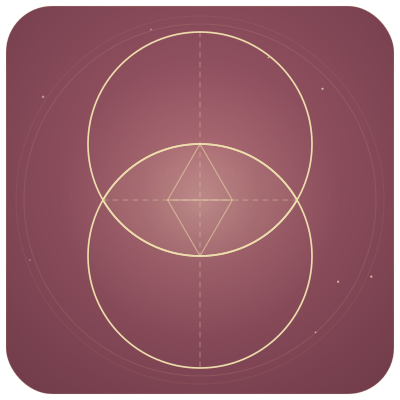

Part of the vesica's power is how little it asks of you. No ruler, no measurement, no numbers. A single compass setting produces the whole figure: one circle, then a second at the same radius centered on any point of the first's circumference. The overlap appears on its own, and its proportions are fixed forever by the construction itself. You cannot draw it wrong. You cannot draw it approximately. Two equal circles sharing a radius produce exactly one vesica, every time, with the same internal mathematics.
Ancient geometers found this significant. In a worldview where creation was understood as an unfolding rather than an assembly — a single principle differentiating into many — a construction that generates rich, exact structure from one repeated gesture looked less like a drawing exercise and more like a diagram of how reality itself proceeds. Whether or not one shares that metaphysics, the observation underneath it is sound: the vesica is genuinely self-organizing. Its properties are consequences, not choices.
Here the ground is completely settled, because it is simply geometry. Call the shared radius 1. The two circle centers sit exactly 1 unit apart — that distance forms the width of the vesica along its short axis. The long axis, running through the two points where the circles intersect, measures √3, approximately 1.732. This ratio of √3 : 1 is not decorative; it is the source of the shape's generative reach, because √3 is the proportion that governs the equilateral triangle and the hexagon.
Euclid saw this immediately. His first proposition constructs an equilateral triangle by drawing two equal circles through each other's centers and connecting the two centers to one of the intersection points. The triangle falls out of the vesica fully formed, with no measurement required. Medieval geometers, working in that Euclidean lineage, treated the vesica as a kind of master key: from it they derived triangles, hexagons, and the proportional systems that shaped Gothic architecture. The pointed arch that defines Gothic cathedrals — Chartres, Salisbury, Notre-Dame — is the upper portion of a vesica piscis, and its structural genius (directing load downward more efficiently than a round Roman arch) came bundled with its symbolism. The builders did not see engineering and meaning as separate categories.
There is even a curious numerical footnote. Ancient mathematicians, lacking decimal notation for irrational numbers, approximated √3 as the ratio 265:153. That number, 153, surfaces again in the Gospel of John as the miraculous catch of exactly 153 fish — a coincidence some scholars read as a deliberate geometric allusion, though this remains an interpretation rather than an established fact. Given that the vesica was already called the "fish bladder" and that the ichthys fish symbol of early Christianity is simply a vesica with its ends extended, the layering is at minimum a remarkable convergence.
The claim in this article's title deserves substantiation. Here is what unfolds from the vesica piscis, step by step, using nothing beyond the original compass setting:
No other simple figure has this kind of downstream reach. It is why geometers speak of the vesica not as one symbol among many but as the grammar the other symbols are written in.

In sacred art, the vesica turned vertical acquired a new name — the mandorla, Italian for almond — and a specific job: framing figures who stand between worlds. Medieval Christian iconography places Christ in Majesty inside a mandorla; the Virgin Mary appears within one in countless Romanesque carvings, including the famous tympanum at Chartres. The visual logic is consistent. One circle represents the divine realm, the other the earthly; the being shown inside the overlap belongs fully to both.
The same intuition appears outside Christianity. In Hindu and Buddhist art, deities and bodhisattvas are framed in almond-shaped aureoles of flame or light. In various goddess traditions, the vesica was read frankly as a yonic symbol — the womb through which spirit enters matter — which is one reason it appears on the well cover at the Chalice Well in Glastonbury, a site layered with Marian, Grail, and older goddess associations. These readings are traditions, and should be held as such: the geometry does not "mean" any of this in a provable sense. But the consistency with which unconnected cultures reached for the same interpretation — overlap as threshold, intersection as birth — says something real about how human minds respond to the form.
A publication like this one owes readers a clean line here. What is settled: the vesica's mathematics, its role in Euclid, its structural use in Gothic architecture, and its documented appearance in religious art across many centuries. What is interpretive: every claim about the shape carrying energy, encoding consciousness, or acting as a portal. Those ideas belong to symbolic and contemplative tradition, not to physics, and no research supports treating the shape as an active force.
What is often overstated in modern sacred-geometry writing is the vesica's universality as a named, venerated symbol in the ancient world. Overlapping circles appear in many old contexts, but a continuous, self-aware "vesica piscis tradition" stretching back to Egypt or earlier is not well documented; much of that narrative was assembled in the nineteenth and twentieth centuries. This doesn't diminish the shape. The mathematics alone — a figure that generates the triangle, the hexagon, three square roots, and the entire Flower of Life lattice from one compass setting — is genuinely extraordinary without embellishment. Nature agrees: lens shapes formed by intersecting wavefronts, dividing cells pressed against each other, and the vibrational patterns that organize the natural world all echo the form, because circles meeting circles is simply what happens when two equal fields interact.
The most honest way to engage the vesica piscis is the way its first students did: draw it. A compass, a pencil, and ten unhurried minutes make an unusually effective focus practice — the geometric equivalent of following the breath. Set the compass once and don't change it. Draw the first circle slowly. Place the point anywhere on its edge and draw the second. Then sit with what appeared: a shape you did not design, with proportions you did not choose, that was implicit in your very first mark.
Some practitioners continue outward, adding circle after circle until the Seed of Life emerges, treating the repetition the way others treat mantra or breath counting. Others simply trace the almond and use it as a visual anchor for meditation on thresholds — the places in life where two things overlap and something third is born. Neither practice requires belief in anything beyond the pencil. Both tend to leave people quieter than they started.
Two circles, one shared radius, and everything else waiting inside the overlap. Of all the figures in the sacred geometric canon, the vesica piscis asks the least and gives the most — a reminder, drawn in the simplest possible strokes, that the meeting place between two things is never empty. It is where the next thing begins.

Sacred geometry tattoos express alignment with the patterns underlying creation — but each symbol carries its own history, meaning, and cultural weight. Here's what the major designs mean and what to weigh before the needle touches skin.

Sacred geometry meditation uses forms like the Sri Yantra, Flower of Life, and Merkaba as anchors for attention. Here are four methods — gazing, visualization, drawing, and breath pairing — and how to practice each one honestly.

Spirals in sunflowers, hexagons in honeycomb, fractals in trees and lungs — a clear-eyed field guide to where sacred geometry genuinely appears in nature, what the science confirms, and what remains beautiful folklore.