The Tree of Life: Ten Sephirot, Twenty-Two Paths, and How the Map Works
Holistic KingdomSeptember 16, 2026Updated September 25, 2026

Some maps show you where things are. This one claims to show you how things became.
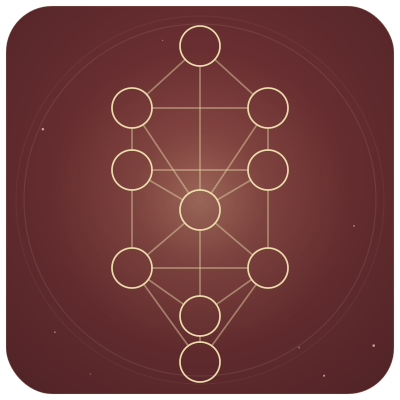
The Tree of Life — Etz Chaim in Hebrew — is the central diagram of Kabbalah, the mystical tradition within Judaism. It depicts ten sephirot (singular: sefirah), usually translated as "emanations" or "spheres," arranged in three vertical columns and connected by twenty-two paths. In Kabbalistic thought, the diagram answers the oldest question in theology: how does an infinite, unknowable divine source — called Ein Sof, "without end" — produce a finite, knowable world? The Tree's answer is that creation happens in stages. Divine energy steps down through ten successive filters, each sefirah expressing one quality of the infinite in a form slightly more concrete than the last, until it arrives at Malkhut, the material world you're sitting in right now. The twenty-two paths, corresponding to the twenty-two letters of the Hebrew alphabet, describe the channels and relationships between those stations.
Crucially, the map is designed to be read in both directions. Downward, it is a cosmology — the story of how the One becomes the many. Upward, it is a psychology and a practice — a ladder the contemplative climbs, quality by quality, back toward the source. That double reading is what makes the Tree of Life one of the most complete symbols in the entire sacred geometry canon: it is simultaneously a diagram of the universe and a diagram of you. Understanding how requires walking through the map station by station.
Honesty first: the Tree of Life as a drawn diagram is medieval, not ancient — though the ideas behind it are considerably older.
The earliest textual root is the Sefer Yetzirah ("Book of Formation"), a short, enigmatic Hebrew work whose dating is genuinely contested — scholars place its composition anywhere between the second and ninth centuries CE. It speaks of "thirty-two wondrous paths of wisdom" by which the world was made: ten sephirot plus the twenty-two Hebrew letters. That arithmetic — ten plus twenty-two equals thirty-two — is the skeleton of every Tree of Life diagram ever drawn.
The sephirot took on their familiar names and personalities in the Kabbalah of twelfth- and thirteenth-century Provence and Spain, culminating in the Zohar, the tradition's masterwork, which circulated in Castile in the late 1200s. The Tree was elaborated further in sixteenth-century Safed by Isaac Luria, whose school gave Kabbalah the dramatic vocabulary of contraction, shattering, and repair that still shapes Jewish mysticism today. The historian Gershom Scholem, who essentially founded the academic study of Kabbalah, traced this development in detail — and was careful to note that the tradition evolved over centuries rather than arriving whole.
One more distinction matters. From the Renaissance onward, Christian and later occult thinkers borrowed the Tree and rebuilt it for their own purposes — the Hermetic Qabalah of the Golden Dawn, with its tarot and planetary correspondences, is the version most people encounter in Western esoteric books. It is a legitimate tradition in its own right, but it is not the same thing as Jewish Kabbalah, and conflating the two flattens both. This article focuses on the Kabbalistic map itself.

Each sefirah is a quality of divine expression — and, in the Kabbalistic view, a corresponding quality in the human soul, since the tradition holds that the person is made in the image of the map. Reading from the top down:
A subtle eleventh presence, Da'at (Knowledge), sometimes appears as an unnumbered station below Keter — a kind of hidden synthesis rather than a sefirah proper. Different schools treat it differently, which is worth knowing when you see Trees drawn with what looks like an extra sphere.
The paths are where the Tree stops being a list and becomes a map. Each of the twenty-two connecting lines is assigned one letter of the Hebrew alphabet, and because Hebrew letters in this tradition are understood as creative forces — the Sefer Yetzirah describes God "engraving" the world with them — each path represents a living relationship between the two sephirot it joins. Chesed and Gevurah are not merely adjacent qualities; the path between them is the ongoing negotiation of generosity and boundary that every person recognizes from their own life.
The vertical architecture matters just as much. The sephirot fall into three columns:
The right-hand Pillar of Mercy (Chokhmah, Chesed, Netzach) carries the expansive, giving, outward-flowing qualities. The left-hand Pillar of Severity (Binah, Gevurah, Hod) carries the structuring, limiting, form-giving qualities. And the central Pillar of Balance (Keter, Tiferet, Yesod, Malkhut) runs like a spine between them — the axis of integration, and traditionally the contemplative's route of ascent.
The design encodes a claim about reality that is easy to miss and hard to forget once seen: neither expansion nor restriction is good or bad on its own. A world of pure Chesed would be a flood; a world of pure Gevurah would be a prison. Everything workable lives in the tension between them. In this the Tree resembles other great balance-diagrams — the interlocking triangles of the Sri Yantra make a similar argument in a completely different visual language.
How does the map actually work? Two classic readings answer that.
The first is the lightning flash — the zigzag route of creation, descending Keter → Chokhmah → Binah → Chesed → Gevurah → Tiferet → Netzach → Hod → Yesod → Malkhut. Trace it on the diagram and you'll see it strike back and forth across the pillars like a bolt, right to left to center, never lingering on one side. Creation, the image insists, is a process of alternation: expansion, then contraction, then balance, repeated at every level of descent. Anyone who has watched an idea move from flash of inspiration to structured plan to finished work has lived this sequence in miniature.
The second is the path of return — the same route climbed in reverse. Here the Tree becomes a contemplative curriculum. The practitioner begins in Malkhut, the embodied everyday, and works upward: steadying the foundation, balancing drive with precision, opening the heart at Tiferet, learning the mature interplay of giving and boundary, and so on toward stations the tradition frankly says cannot be reached by effort alone. Later Kabbalists layered a further structure over this: the Four Worlds (Atziluth, Beriah, Yetzirah, Assiyah — emanation, creation, formation, action), with the entire Tree repeating within each, like a map containing smaller copies of itself.
It should be said plainly that all of this is theology and contemplative psychology, not physics. The Tree of Life is a symbolic system developed within a living religious tradition — its truth-claims are of the same kind as those of any mystical framework, and it deserves to be engaged on those terms rather than dressed up as science.

Within the broader family of sacred geometry, the Tree of Life occupies an unusual position: it is a relational diagram rather than a purely geometric one. The Seed of Life and the Flower of Life emerge from compass-and-circle construction; the Tree emerges from theology first, with the geometry serving the ideas. That said, the two families kept meeting. Renaissance and later esoteric writers noticed that the Tree's ten nodes can be overlaid on the Flower of Life grid, and modern authors frequently draw connections between the sephirot and the nodal structure of Metatron's Cube — associations that are evocative and genuinely old in spirit, but that belong to the history of interpretation rather than to the original Kabbalistic sources. It's a distinction worth keeping, the same way it's worth separating the real mathematics of the golden ratio from the myths that trail behind it.
What the Tree uniquely contributes to the symbol family is direction. Most sacred geometry figures are static mandalas of wholeness. The Tree has a top and a bottom, a descent and an ascent, a current running through it. It is less a snapshot of creation than a wiring diagram.
You don't need to be a Kabbalist — and out of respect for the tradition, no article can make you one; serious Kabbalah is studied within Judaism, with teachers, over years. But the Tree's core insight travels well: that a whole life requires both pillars. Seasons of generous expansion and seasons of firm boundary. Inspiration and structure. Drive and precision. And a center line that keeps returning you to balance.
As a reflective tool, that's genuinely useful. Sit with the diagram and ask where your own weight currently rests — too far into Chesed's boundless yes, or Gevurah's guarded no? It pairs naturally with journaling or quiet contemplation, and if the idea of working with a symbolic map appeals to you, a simple meditation practice gives the reflection somewhere to land.
The old teachers said the Tree is drawn upside down — its roots in heaven, its branches reaching into the world. Whatever you make of the metaphysics, the image holds: whatever is best in a life tends to be fed from somewhere quieter and higher than the noise of the day. The map's real invitation is simply to keep climbing toward it.

Sacred geometry tattoos express alignment with the patterns underlying creation — but each symbol carries its own history, meaning, and cultural weight. Here's what the major designs mean and what to weigh before the needle touches skin.

Sacred geometry meditation uses forms like the Sri Yantra, Flower of Life, and Merkaba as anchors for attention. Here are four methods — gazing, visualization, drawing, and breath pairing — and how to practice each one honestly.

Spirals in sunflowers, hexagons in honeycomb, fractals in trees and lungs — a clear-eyed field guide to where sacred geometry genuinely appears in nature, what the science confirms, and what remains beautiful folklore.